Why Do We Just Accept It?
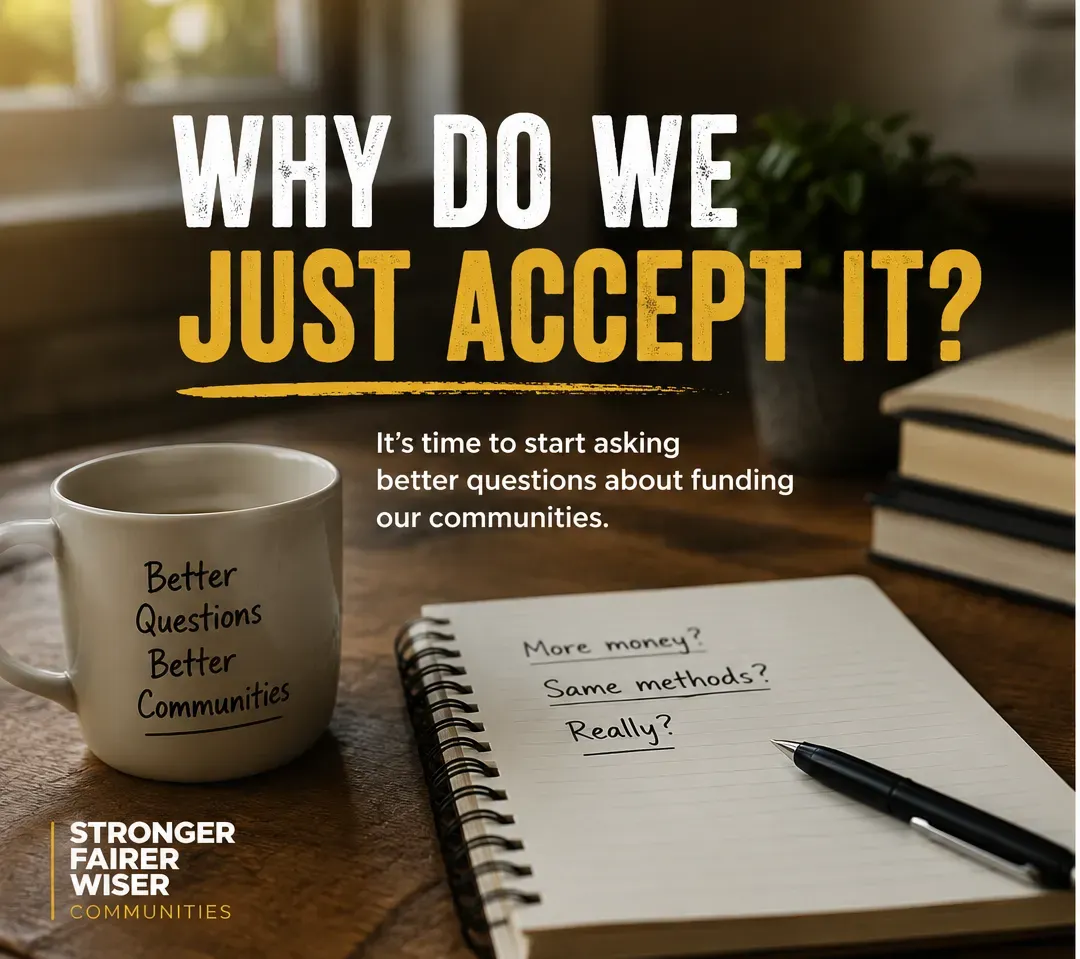
Why Do We Just Accept It?
Jul 16, 2026
Over the past few months, I've had the privilege of speaking with people from all kinds of communities. Football clubs, charities, churches, community groups and people trying to make a difference in their local area.
Although their missions are all different, one thing keeps coming up in almost
every conversation: "Funding".
Some need money to keep the lights on, others want to expand what they're doing, some have ambitious plans but simply don't have the resources to make them happen.
None of that surprised me.
What did surprise me was something else.
Nobody ever questioned the system itself.

The conversation almost always centred around the same things. Another fundraiser. Another grant application. Another sponsorship opportunity. Another appeal for donations.
It made me stop and think.
Why do we just accept that's how it has to be?
If you think about it, we challenge almost every other part of our lives. We embrace new technology, new ways of communicating, new ways of working and new ways of doing business. We don't think twice about replacing an outdated system if something better comes along.
Yet when it comes to funding our communities, many of us still work from the assumption that the only option is to keep asking people for money.
Somewhere along the way, we've accepted that as normal.
Maybe it is.
Or maybe we've simply stopped asking the question.
I'm not suggesting fundraising is wrong, far from it, fundraising has achieved incredible things and always will have an important place.
But I can't help wondering if we've limited the conversation.
Instead of asking, "How do we raise more money?", what if we also started asking, "How could communities become more financially sustainable?"
They're very different questions.
One focuses on the next campaign,
The other focuses on the future.
I don't pretend to have all the answers, and that's not really the point of this article.
The point is that good ideas often begin with good questions.
Perhaps it's time we started asking some different ones.
What do you think? Have we simply accepted that "that's just the way it is," or do you think it's time to rethink how communities fund themselves?